

Taking some chips off the table – Counterpoint November 2026
8 mins to read this article
Daniele Antonucci
Daniele Antonucci is a managing director, co-head of investment and chief investment officer at Quintet Private Bank. Based in Luxembourg, he jointly chairs the investment committee, owning decision-making and performance outcomes. As head of research, Daniele oversees the investment strategy feeding into portfolios and the teams of specialists across asset classes and solutions, ranging from macro, fixed income and equities to funds, alternatives, and structured products and derivatives. He leads the network of chief strategists, communicating the house view on the economy and markets to financial advisors, clients and the media.
Prior to joining Quintet in 2020 as chief economist and macro strategist, Daniele served as chief euro area economist at Morgan Stanley in London. He completed the High Performance Leadership Programme at Saïd Business School, University of Oxford, holds a master’s degree in economics from Duke University and graduated from the Sapienza University of Rome. Featured in The Economist and Financial Times and often quoted in the generalist press, he’s a published author in finance and economics journals and investment magazines, a frequent speaker on CNBC and Bloomberg TV, and an ECB Shadow Council member.

What you need to know
-
We remain positive about the medium-term outlook: the global economy is expanding, corporate profits are growing and investment in AI continues to support economic activity.
-
The near term looks less straightforward: higher oil prices, geopolitical tensions and the approaching US midterm elections have widened the range of possible outcomes at a time when several markets have already performed strongly.
-
We are taking some profits and adding resilience: after strong gains, we are closing our tactical overweight in emerging market equities and increasing our exposure to US Treasuries. This reflects the changing balance of risks rather than a less positive view of the longer-term opportunities.
Note: Any reference to portfolio positioning relates to our flagship core discretionary portfolios. Clients invested in other strategies, or in bespoke and advisory portfolios, should consult their Client Advisor.
A good outlook does not mean taking every risk
There is still plenty to like about the medium-term investment outlook. The global economy is growing despite rising energy prices, higher interest rates and political uncertainty. Corporate profits are also growing, supported by the significant investment in building the infrastructure behind AI.
This is why we still have a positive view on equities. It’s also why we don’t believe we’re in an AI bubble. Demand for computing power, cloud infrastructure and advanced semiconductors is generating revenues and earnings across the technology supply chain. Over time, we believe the potential productivity benefits can extend well beyond the technology sector.
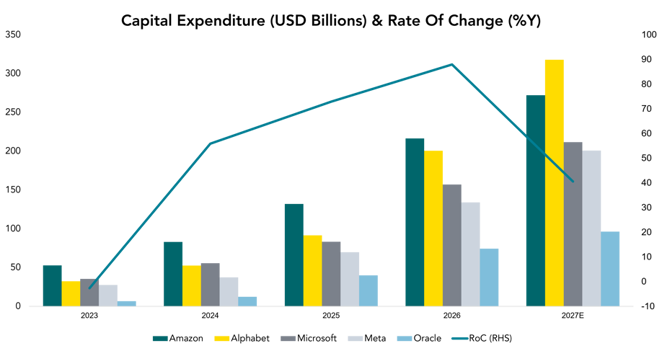
However, as the sums involved become larger, the economics deserve closer attention. Questions are increasingly being asked about how AI projects are financed, whether future revenues can justify the money being committed and what returns they can ultimately generate.
We also expect the extraordinary pace of AI spending growth to ease. As the investment base grows, maintaining the same rate of expansion requires ever larger amounts of capital. Our central scenario is therefore for spending to continue rising, but at a slower pace.
Spending can therefore grow more slowly without signalling the end of the AI investment cycle. We continue to see AI as a powerful long-term investment theme, even as the economics of individual projects and companies come under greater scrutiny. The longer-term outlook remains supportive, but the risks over the coming months have increased.
Source: In-house Research, LSEG Datastream. Past performance is not a reliable indicator of future returns.
Why we are taking profits in emerging markets
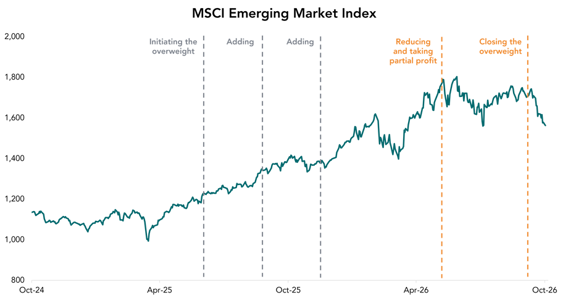
Our overweight position in emerging market equities has performed well. Improving earnings, strong Asian markets and exposure to the global technology cycle have all helped.
We are now taking some profits and returning to a neutral position. But we are not walking away from emerging markets.
We still see attractive long-term opportunities, particularly in Asian technology companies and the semiconductor supply chain. We also remain positive on the longer-term AI investment cycle. However, there are two reasons why we think the near-term balance between risk and potential return has become less attractive.
Firstly, technology makes up a large part of the emerging market equity universe. That exposure has supported performance as AI investment has grown, while giving investors another way to participate in the theme beyond the large US technology companies. But it also means US and Asian technology markets are increasingly exposed to the same questions from investors about AI spending and the returns it can ultimately generate.
Secondly, many of the Asian markets we invest in are particularly exposed to higher oil prices. The largest Asian emerging markets are oil importers, making them vulnerable to a further rise in prices if tensions in the Middle East escalate. If that were accompanied by a stronger US dollar or investors pulling money out of emerging markets, the pressure could become more pronounced.
Being positive about emerging markets over several years does not mean maintaining an overweight position at every point in the cycle. For now, we believe a neutral allocation is more appropriate.
Source: In-house research, LSEG Datastream. Past performance is not a reliable indicator of future returns.
Adding to US Treasuries while staying selectively constructive
We are reallocating the proceeds into US Treasuries, hedged into local currency to remove the impact of exchange-rate movements. This builds on our recent decision to reduce European government bonds and increase exposure to US Treasuries.
The aim is to improve portfolio resilience and capture yield. US Treasuries can help diversify our equity exposure and may perform well if growth slows, geopolitical tensions rise or equity markets become more volatile. They could also benefit if the US midterm elections result in a more divided government, making further increases in government spending less likely.
Treasuries don’t protect portfolios in every scenario. A further oil shock, for example, could push inflation expectations and bond yields higher, reducing their defensive qualities. Even so, we believe they provide a useful counterweight to some of the risks we currently see.
None of these changes alters our constructive medium-term outlook. They reflect a judgement that, after a period of strong returns, some of the risks have become less attractive to take today.
For us, this argues for taking some chips off the table: realising gains where markets have rewarded us, retaining exposure to the opportunities we continue to believe in and adding some resilience if the months ahead prove less straightforward.
This document has been composed by InsingerGilissen, branch of Quintet Private Bank (Europe) S.A. (“InsingerGilissen”). InsingerGilissen is supervised by the ECB and CSSF and under limited supervision by the AFM and DNB. InsingerGilissen has its registered office at Herengracht 537, 1017 BV Amsterdam, The Netherlands (Chamber of Commerce-number: 80510132). Quintet Private Bank (Europe) S.A. has its statutory seat in Luxembourg.
This document is for information purposes only, does not constitute individual (investment or tax) advise and investment decisions must not be based merely on this document. Whenever this document mentions a product, service or advice, it should be considered only as an indication or summary and cannot be seen as complete or fully accurate. All (investment or tax) decisions based on this information are for your own expense and for your own risk. You should (have) assess(ed) whether the product or service is suitable for your situation. InsingerGilissen and its employees cannot be held liable for any loss or damage arising out of the use of (any part of) this document.
All copyrights and trademarks regarding this document are held by InsingerGilissen, unless expressly stated otherwise. You are not allowed to copy, duplicate in any form or redistribute or use in any way the contents of this document, completely or partially, without the prior explicit and written approval of InsingerGilissen. See the privacy notice on our website for how your personal data is used (https://www.insingergilissen.nl/en-gb/privacyencookies).